Website Strategy for Digital Agencies: Positioning Expertise and Results
Position your agency to win: strategy, proof, and conversion architecture done right with Flowscape's Webflow builds. Book a call to sharpen your site.

We’ll review your website, identify conversion gaps, and outline a practical plan to turn it into a qualified lead engine.


A digital agency website has a harder job than almost any other category of B2B site. It must demonstrate the very expertise it is selling, position the agency against dozens of competitors making similar claims, and convert buyers who are evaluating multiple agencies simultaneously and know exactly what good looks like. Most agency websites fail this brief not because the agency lacks capability, but because the website does not communicate that capability in a way that creates differentiation and drives action.
Key things to know:
- Why "full-service" positioning is the single most common reason agency websites fail to convert qualified prospects, and what to say instead
- How the three-second clarity test applies specifically to agency websites, and why most agencies fail it despite spending significant effort on design
- The case study structure that drives B2B purchase decisions, and why vague outcome claims like "we increased their traffic" are now indistinguishable from no proof at all
- Why 92% of B2B buyers are more likely to purchase after reading a trusted review, and how that data changes where testimonials belong on an agency website
- How video testimonials outperform written testimonials by 80% in conversion terms, and when the production investment is commercially justified
- The specialisation signal: why agencies that position around a specific industry, service type, or buyer problem consistently win against generalists competing for the same client
- Why the agency website is a live demonstration of the agency's capability and how misalignment between the work the agency sells and the experience its own website delivers costs real business
- How social proof and trust signals placed strategically in the decision zone drive B2B agency conversion rates by 15 to 30%
In 2025, more than 63% of businesses outsourced marketing or digital work to an agency or third party, a sharp increase from the prior year. That growing market does not make the agency sales environment easier. It makes the field more crowded, the buyer more experienced, and the requirement to differentiate more urgent. The agency website is where that differentiation either happens or fails. Getting the strategy right is not a design question. It is a positioning and content architecture question that the design serves.
The Positioning Problem: Why "Full-Service" Loses Every Time
The most common website strategy failure for digital agencies is attempting to serve everyone by claiming to do everything. Homepage headlines that lead with "full-service digital marketing," "end-to-end creative solutions," or "everything your brand needs" communicate one thing clearly to a prospective buyer: there is no particular reason to choose this agency over any other.
Buyers hiring agencies are making a significant financial and operational commitment. They want to hire the best agency for their specific situation, not the most capable generalist. The agency that positions itself as the specialist in their industry, their growth stage, or their specific problem type has a structural advantage over the generalist, regardless of which has more total capability.
In 2026, the most effective agency positioning answers a question that most agency websites never ask: what is the one thing this agency is definitively better at than any alternative a prospect would reasonably consider? That answer should drive the homepage headline, the service page structure, the case study selection, and the conversion copy. It should be specific enough that the right buyer immediately recognises it as relevant, and specific enough that the wrong buyer recognises it is not for them.
Both outcomes are strategically valuable. An agency website that converts the right prospects at a high rate and disqualifies the wrong ones efficiently is more commercially valuable than one that attracts broad enquiry at low conversion. Specificity is not a risk in agency positioning. Vagueness is.
The Three-Second Clarity Test for Agency Websites
Agency websites face the same five-second relevance test as every other B2B site, but with an additional dimension: the visitor is not just asking whether this agency can solve their problem. They are also asking whether they want to work with these people, whether the aesthetic reflects the standard of work they expect, and whether the experience of navigating this site reflects the experience of working with this team.
That makes the three-second test harder for agencies than for most B2B products. The homepage must answer what the agency does and for whom, while simultaneously demonstrating the quality of work through the execution of the site itself. An agency selling high-performance conversion-focused design that operates a slow, cluttered, or visually inconsistent website is signalling a misalignment between what it sells and what it delivers.
The practical test is direct: can a visitor who has never encountered the agency land on the homepage and correctly state, within three seconds, what the agency specialises in, who its typical clients are, and what action the page is asking them to take? For most agency homepages, the honest answer is no. The headline describes a mission rather than a service. The subheadline restates the headline in slightly different language. The CTA is a generic "get in touch" that commits to nothing and promises nothing.
Fixing this does not require a redesign. It requires a positioning decision made before a single word of copy is written, and then disciplined execution of that decision across every surface of the site.
Case Studies: The Highest-Leverage Asset on Any Agency Website
For agency buyers, case studies are the primary evaluation mechanism. They answer the question that no headline or testimonial can answer at sufficient depth: has this agency solved a problem similar to mine, for a client similar to me, and can they prove it?
The data on this is direct. Social proof and trust signals placed strategically in the decision zone drive B2B conversion rates by 15 to 30%. Case studies with specific, structured outcomes, including company type, problem, solution, and measurable result, are the highest-trust proof format available to an agency. They are also the most consistently misexecuted.
The common failure is vagueness. "We increased their organic traffic" is not a case study. It is a claim. "We increased organic traffic by 340% in nine months for a Series B SaaS company targeting mid-market procurement teams in the UK" is a case study. The specificity serves multiple functions simultaneously. It demonstrates the result, which is the primary trust signal. It qualifies the relevance, which is the secondary function: a reader in a similar situation recognises their own context in the description and connects the outcome to their own ambition. It also creates the kind of citation-ready content that AI-powered discovery surfaces in research contexts, where structured entity relationships and specific metrics are increasingly important for visibility.
Case study structure matters as much as case study content. A problem-solution-result architecture is the most readable format for buyers who are comparing multiple agencies. The problem section creates emotional relevance. The solution section demonstrates strategic and executional capability. The result section delivers the proof that converts. Burying the result at the bottom of a long narrative is a structural mistake: the outcome should be visible within the first two scrolls, not as a reward for reading to the end.
Social Proof: Placement Is as Important as Content
Agency websites that collect testimonials and display them on a standalone reviews page have made a placement decision that significantly reduces the commercial value of those testimonials. 92% of B2B buyers are more likely to purchase after reading a trusted review. That conversion influence is strongest when the review appears at the moment the buyer is deciding whether to take action, not on a page they have to navigate to.
Testimonials embedded on service pages, near pricing or engagement information, and alongside CTAs convert at higher rates than testimonials isolated on a dedicated page. The goal is to surface the right validation at the exact moment the buyer's decision-making process peaks. A specific testimonial from a named client in a recognisable company, placed immediately above or beside the primary contact CTA, closes the gap between interest and action more reliably than any amount of copy.
Video testimonials represent a meaningful incremental investment that is commercially justified for higher-value agency engagements. Video format outperforms written testimonials by 80% in conversion terms because it adds the social and emotional dimension that text cannot replicate. A two-minute video of a client describing their experience, in their own words, with their name, title, and company visible, is the highest-trust social proof format available to any agency. It is particularly effective on service pages targeting the specific buyer type the client represents.
The specificity standard that applies to case studies applies equally to testimonials. A client saying "they were great to work with and delivered results" provides less conversion value than a client saying "the landing page Flowscape built for our product launch drove a 34% increase in demo requests in the first month." The former is pleasant. The latter is proof.
The Website as a Live Portfolio
Every agency website is a live demonstration of what the agency is capable of doing for clients. This creates a standard that no other B2B category faces in the same form: the buyer can directly evaluate the agency's craft by navigating the site itself. Page speed, visual consistency, copy quality, navigation clarity, and conversion architecture are all visible to a buyer who knows what to look for.
In practice, this means agency website investment decisions are not just marketing decisions. They are portfolio decisions. An agency that sells high-performance Webflow builds and operates its own site on a slow, poorly structured WordPress installation is communicating something directly about the gap between what it sells and what it builds for itself.
88% of users are unlikely to return after a poor website experience. For agency buyers, who are evaluating multiple options and making a purchase decision that will affect their business for a year or more, the threshold for that negative first impression is lower than it is for most categories. A slow load, an inconsistent layout, or a navigation structure that requires effort to understand signals the same quality that would be delivered on a client project.
Top-performing agency websites in 2026 hold bounce rates below 35% and session durations exceeding three minutes. Those metrics reflect a visitor who found relevance quickly, navigated deliberately, and spent enough time to build the conviction that drives an enquiry. The site experience that produces those metrics is not an accident of design taste. It is the result of a strategy that aligns positioning, proof, and architecture around the specific buyer the agency wants to serve.
The Conversion Architecture of a High-Performing Agency Website
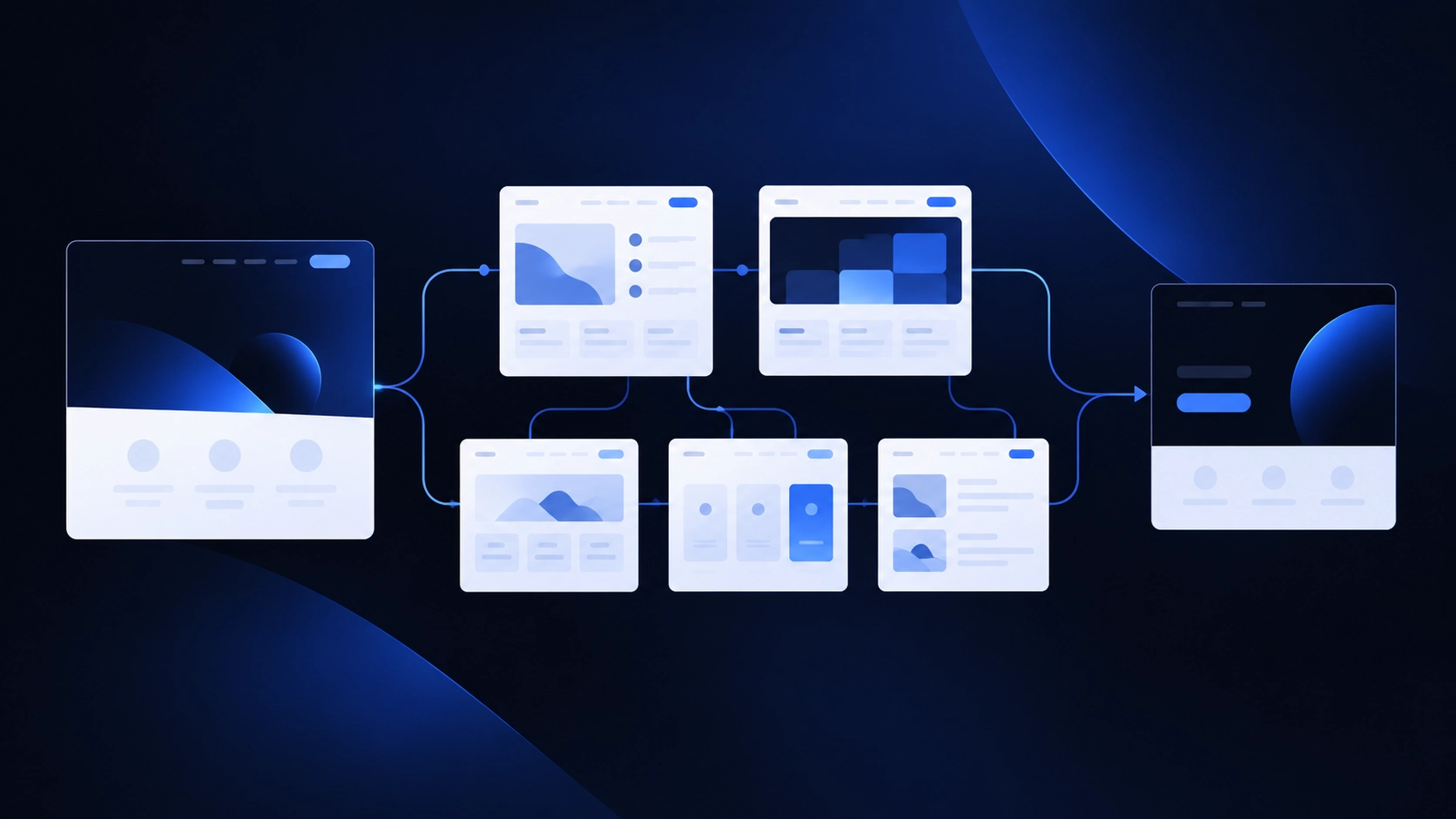
The conversion architecture of an agency website follows a specific logic. The homepage earns the click to a service or work page. The service page builds the case for capability and specificity. The case study or work section provides the proof that converts intent into enquiry. The contact or booking flow removes friction from the conversion event itself.
Each stage of this journey has a specific job, and the most common agency website failure is compressing the entire journey onto the homepage. A homepage that attempts to communicate the agency's full capability, display its complete portfolio, present multiple testimonials, and offer five different conversion paths is doing none of those jobs effectively.
Service pages earn the trust that converts. They should be specific enough that a visitor can confirm relevance, demonstrate enough depth that a buyer can assess capability, and provide enough proof that the decision to contact feels low-risk. The CTA on a service page should reflect the natural next step for a buyer at that stage: a conversation, a project brief, or a portfolio review, depending on the engagement model.
For agencies whose typical engagement starts with a discovery call or a scoping conversation, the CTA should remove as much friction as possible from booking that call. A scheduling tool embedded on the page, with no intermediate form step, converts at higher rates than a contact form that triggers a response-time delay. Every hour between a prospect's decision to engage and their first conversation with the agency is an hour in which a competitor with a lower-friction process can fill that gap.
If you are a digital agency building or rebuilding your website and want the positioning, design, and conversion architecture to work as a single system, Flowscape's B2B web design service delivers Webflow-built agency sites that demonstrate capability through execution and convert the buyers you are trying to reach.
FAQs
What should a digital agency's homepage headline say? The headline should answer what the agency does, for whom, and why it is the right choice, as specifically as possible in as few words as possible. Generic positioning language like "full-service digital agency" or "creative solutions for ambitious brands" fails the three-second clarity test because it does not differentiate the agency from any competitor. The most effective agency headlines are specific about the industry served, the problem solved, or the buyer type targeted. A headline that qualifies the right buyer quickly is more commercially valuable than one that appeals broadly and converts weakly. The test is whether a prospect in your target market reads the headline and immediately thinks it is written for them.
How should digital agencies structure case studies on their website? The most effective structure is problem, solution, and result, with the outcome visible within the first two scrolls rather than buried at the end of a long narrative. The problem section creates relevance for buyers in a similar situation. The solution section demonstrates strategic and executional capability. The result section delivers the proof that drives enquiry. Results should be specific and quantified: percentage improvements, revenue figures, pipeline values, and time frames are all more persuasive than directional claims. Vague outcomes like "increased their traffic" are now indistinguishable from no proof at all in a market where buyers read multiple agency sites before making contact.
Where should testimonials appear on an agency website? Testimonials convert best when placed at the moment of decision rather than on a standalone reviews page. The highest-impact placements are on service pages near pricing or engagement information, adjacent to primary CTAs, and at the bottom of case studies where a buyer has already built interest. 92% of B2B buyers are more likely to purchase after reading a trusted review, but that conversion influence requires the review to be present at the moment the decision is forming, not on a page the buyer has to navigate to separately. Specific, named testimonials with measurable outcomes outperform generic praise by a significant margin in B2B contexts.
Why does specialisation matter so much for agency website positioning? Specialisation is the primary mechanism through which agencies create the impression of being the best choice for a specific type of client, rather than a competent choice among many. Buyers hiring agencies are making a substantial financial and operational commitment. They want the specialist in their situation, not the generalist with the broadest capability claim. An agency positioned around a specific industry, growth stage, or problem type has a structural advantage in converting the buyers who fit that profile, even against larger generalist competitors. The concern that specialisation loses prospects who fall outside the positioning is generally outweighed by the improvement in conversion rate among the prospects who are the best fit.
How does the quality of an agency's own website affect its ability to win new business? Directly and significantly. An agency website is a live portfolio item that buyers evaluate using the same criteria they would apply to any design or digital deliverable. Page speed, visual consistency, navigation clarity, copy quality, and conversion architecture are all observable signals about the standard of work the agency delivers. 88% of users are unlikely to return after a poor website experience. For agency buyers who are assessing capability through the experience of the site itself, a site that underperforms on any of these dimensions is communicating something specific about the quality gap between what the agency sells and what it builds. Top agency sites hold bounce rates below 35% and session durations exceeding three minutes, reflecting a visitor experience that builds conviction rather than eroding it.

We’ll review your website, identify conversion gaps, and outline a practical plan to turn it into a qualified lead engine.