Signs Your SaaS Company Has Outgrown Its Current Website
Discover the key signs your SaaS website is limiting growth. Fix speed, outdated messaging, and platform issues to boost conversions and increase revenue fast.

We’ll review your website, identify conversion gaps, and outline a practical plan to turn it into a qualified lead engine.


These warning signs indicate when your SaaS website has become a growth bottleneck rather than a revenue driver:
- Site speed directly impacts revenue - Every second of delay increases bounce rates by 32%, with businesses losing an average of 15% annual revenue from poor performance
- Outdated messaging kills conversions - When your website describes old features or retired pricing models, prospects question your reliability and well-managed operations
- Legacy platforms create technical debt - WordPress sites with 20-30 plugins experience conflicts, crashes, and security vulnerabilities that require constant developer intervention
- Disconnected systems block growth - When your website can't integrate with CRM or sales tools, marketing campaigns lead to broken experiences and lost leads
- Mobile performance determines rankings - With mobile-first indexing and 65% of traffic from mobile devices, slow mobile experiences directly impact both search visibility and revenue
The cost of maintaining an outdated website far exceeds the investment in modern SaaS website design services. Addressing these issues removes your biggest growth bottleneck and delivers measurable returns faster than most marketing campaigns.
Your saas website design isn't a one-time project. It's a living sales asset that either amplifies your growth or undermines it. SaaS platforms solve early-stage problems quickly, but organisations reach a point where efficiency declines despite rising software spend. That inflexion point often shows up first in your website. Every additional second of load time increases bounce rates by 32%. The cost of delayed follow-up or disorganised communication often exceeds the cost of upgrading business tools.
We'll walk through the critical signs your site has become a growth bottleneck. Speed issues cost you bookings. Outdated messaging and platform limitations hold you back. Your website blocks other marketing efforts. We'll also explore when working with a saas website design agency or investing in saas website design services makes sense.
Your site is slow, and it's costing you bookings
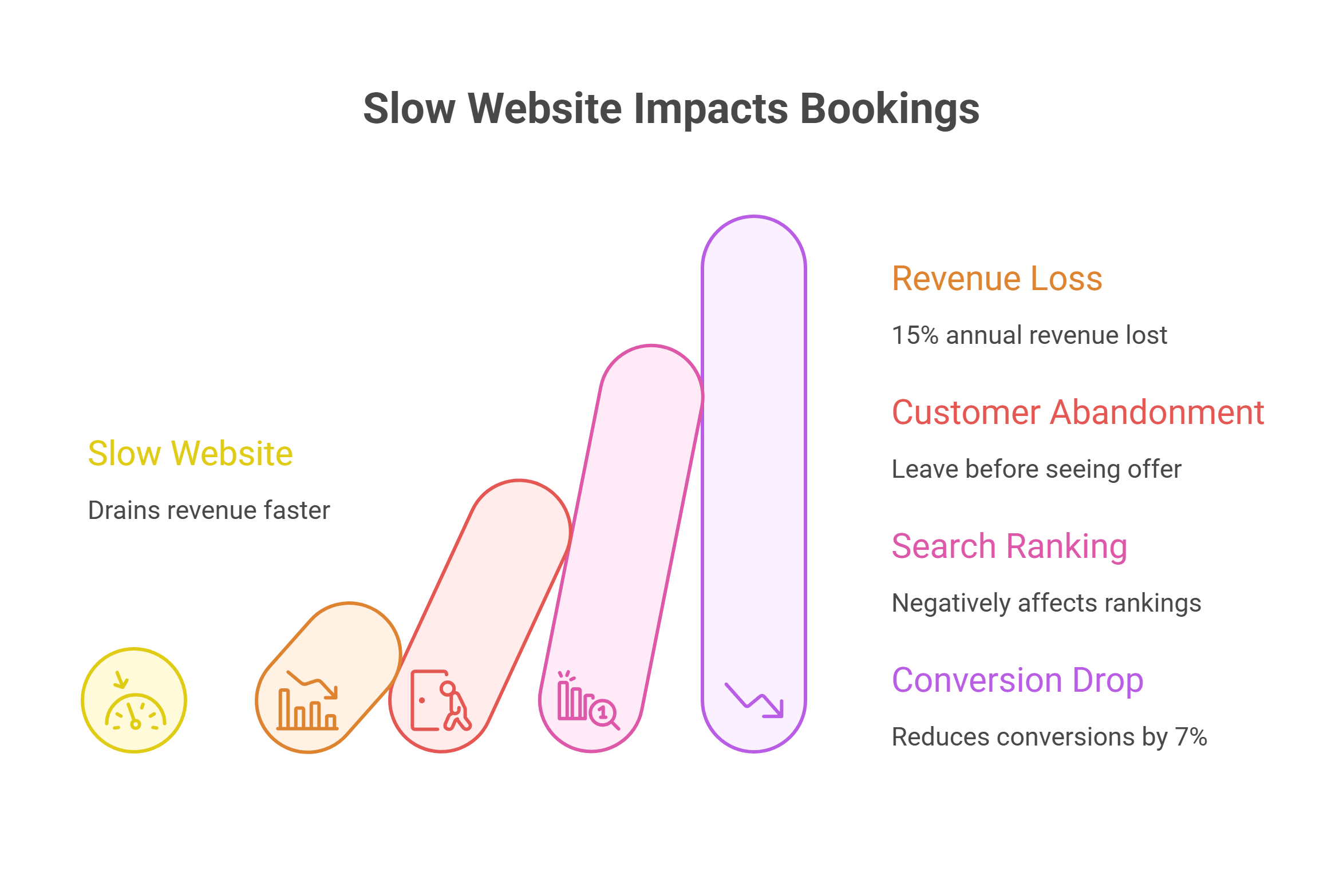
Poor website performance drains revenue faster than most SaaS companies realise. Businesses lose an average of 15% of annual revenue due to slow site performance, with companies reporting an average loss of $20,172 per year. Potential customers leave before they ever see your offer, your sales team, or your product if your site takes too long to load.
Core Web Vitals effect on conversion rates
Google's Core Web Vitals measure everything in user experience: Largest Contentful Paint (LCP) for loading speed, Interaction to Next Paint (INP) for responsiveness, and Cumulative Layout Shift (CLS) for visual stability. Optimal performance requires LCP under 2.5 seconds, INP below 200 milliseconds, and CLS under 0.1.
The conversion effect proves substantial. Rakuten 24's Core Web Vitals optimisation delivered a 53.37% increase in revenue per visitor and a 33.13% increase in conversion rate. redBus saw a 7% increase in sales after improving INP. Carpe achieved a 5% conversion rate increase alongside a 10% traffic boost following a 52% faster LCP.
Mobile load times matter more than desktop
Mobile performance carries disproportionate weight. Google's mobile-first indexing means your mobile version determines rankings on mobile and desktop. Over 53% of mobile users abandon sites that take over 3 seconds to load. Mobile pages take 70.9% longer to load than desktop.
The speed sensitivity is markedly different. Mobile users show 2 to 3 times higher speed sensitivity compared to desktop users. Over 65% of total web traffic now originates from mobile devices, and a slow mobile experience directly affects both search visibility and revenue.
How page speed affects search rankings
Page speed remains a confirmed Google ranking factor as of April 2023. Search engines interpret high bounce rates and low engagement as signals of poor user experience if pages load slowly, which negatively affects rankings. Mobile performance influences both mobile and desktop rankings due to mobile-first indexing.
The real cost of a 3-second delay
Bounce probability jumps by 32% if load time increases from 1 to 3 seconds. That figure reaches 90% at 5 seconds. Financial losses compound quickly. A one-second delay reduces conversions by about 7%. A site that generates $1 million annually loses roughly $210,000 yearly from a 3-second delay.
SaaS companies that invest in saas website design services see measurable returns from speed optimisation. Even 100-millisecond improvements can lift conversion rates and turn technical performance into a direct revenue driver.
Your website describes a company you no longer are
Most websites get built around a launch deadline instead of a long-term strategy. Decisions focus on how things look rather than how they function, and this creates problems down the line. Your business grows, you add services, refine your offer, and get clearer about ideal clients. The website becomes disconnected from reality if it can't keep up. You end up with a business in 2026 being represented by a website designed for the business you were in 2023, and this damages conversion.
Outdated messaging that doesn't match current offerings
Content that talks too much about the company and not enough about the customer fills pages but says little. Phrases like "we are passionate" and "we offer state-of-the-art solutions" sound impressive but provide no real value. Visitors aren't looking for passion. They're looking for understanding. Prospects question whether your business is reliable or well-managed at the time your homepage still describes old features or retired pricing models.
Visual design that feels stuck in 2019
Outdated layouts, inconsistent typography, cluttered pages and low-quality visuals weaken perceived professionalism. Design trends from 2019 included animated GIFs and flat minimalist approaches. A clean, modern interface communicates that the business is active and attentive to what users need. Poor spacing, clashing colours and pixelated images signal a lack of attention to detail.
Missing features your competitors now have
88% of internet users won't return to a website after one bad experience. Competitors capture opportunities that could have gone to your business if they provide faster, clearer and more engaging websites. Users gravitate toward platforms that feel professional and easy to use.
Your brand has evolved but your site hasn't
A brand refresh matches who you've become and where you're going. The disconnect costs you qualified leads at the time offerings, audience or business model outgrow your original brand thesis. A modern, cohesive brand identity signals credibility and professionalism.
You're on a platform that's slowing you down
Legacy platforms accumulate problems faster than most teams can fix them. WordPress sites running 20 to 30 plugins experience conflicts that cause crashes, broken features and unpredictable behaviour after routine updates. One client reduced plugins from 18 to just 7, cutting load time to under 2.5 seconds and eliminating late-night site failure calls.
Technical debt from old themes and plugins
Outdated plugins and themes create compatibility issues with modern WordPress versions, PHP updates and other site components. Plugin conflicts break forms, shift layouts and slow page loads. 93.25% of all WordPress vulnerabilities exist in plugins, whilst only 1.3% occur in core software. Custom code written years ago clashes with current versions and causes glitches in interactive features and display issues on mobile devices.
Security risks from outdated WordPress versions
Hackers exploit vulnerabilities in outdated WordPress installations and plugins. More than 10,000 websites have been compromised through outdated WordPress versions and plugins in large-scale malware attacks. 52% of known WordPress vulnerabilities come from outdated plugins, so they serve as the main entry point for breaches.
You're afraid to update anything
Many business owners dread updates because something always breaks. Clicking update on a live site without testing is risky. Updates don't always work together. New code can undo custom work, or changes may expose hidden issues. A staging environment allows testing before applying updates to the live site and prevents downtime and data loss.
Custom features require messy workarounds
Custom-coded sites require developer intervention for simple changes. This creates bottlenecks that slow campaign velocity. A global retailer's Black Friday campaign launched late across 12 regions due to developer backlogs and cost $2 million in missed revenue and $50,000 in developer costs.
When to think about working with a SaaS website design agency
SaaS website design services that focus on flexibility deliver end-to-end ownership including platform choices, integrations and accessibility. A proper partner discusses security, scalability and post-launch maintenance as clearly as design. This ensures the build remains maintainable and resilient.
Your website is blocking everything else
A disconnected website creates friction that extends way beyond the reach and influence of the site itself. Marketing campaigns guide traffic to experiences that fail to convert. Sales teams struggle to share relevant materials, and disconnected systems prevent information about potential customers from flowing where it needs to go.
Marketing campaigns result in a broken experience
Website experience determines conversions because ads capture attention, but the website decides whether visitors become customers. About 70% of shoppers abandon their cart before completing checkout. The average eCommerce website converts only 1.6% of visitors. Paid traffic sent to slow or poorly designed websites frustrates users and drives potential buyers away.
Sales team can't point prospects to relevant content
The American Marketing Association reports that 90% of marketing deliverables are not used by sales. Sales reps spend at least 25% of their time on administrative tasks instead of actually selling. Your sales team will never use content if they can't locate it easily.
No integration with your CRM or sales tools
A website that isn't integrated with your CRM stores information about potential customers that convert via forms or downloads in one system but doesn't pass them to the CRM with the right data. Sales teams don't get the signals they need at the time a prospect is hot.
Content updates require developer intervention
Custom features require developer intervention for simple changes and create bottlenecks that slow campaign velocity.
Why modern SaaS website design services focus on flexibility
Modern saas website design services prioritise flexible architectures that support integrations and rapid updates. They also enable scalability without technical dependencies.
Conclusion
Your website either amplifies growth or undermines it. Slow load times and outdated messaging compound into one problem: lost revenue. Platform limitations and disconnected systems make things worse. These issues are fixable, and the returns come fast. Addressing site performance and messaging alignment realises more potential than most marketing campaigns ever will. The right SaaS website design services partner helps you rebuild more than a website. You remove your biggest bottleneck.
FAQs
How often should a SaaS company redesign its website? Whilst there's no fixed rule, a good benchmark is every two to three years to ensure your site aligns with current design trends and functional best practises. However, you should consider a redesign sooner if you're experiencing performance issues, outdated messaging that doesn't match your current offerings, or if your website is blocking marketing and sales efforts.
How does website speed affect SaaS conversions? Website speed has a direct impact on conversions and revenue. Every additional second of load time increases bounce rates by approximately 32%, and businesses lose an average of 15% of annual revenue due to slow site performance. A one-second delay can reduce conversions by roughly 7%, meaning significant financial losses for SaaS companies.
What are the signs that a SaaS website has become outdated? Key indicators include messaging that no longer matches your current product offerings, visual design that feels dated, missing features that competitors now have, and a brand identity that hasn't evolved with your business. If your website describes old features or retired pricing models, it damages credibility and conversion rates.
Why do legacy platforms create problems for growing SaaS companies? Legacy platforms accumulate technical debt through outdated plugins, themes, and custom code that conflict with modern versions. WordPress sites running 20-30 plugins often experience crashes, security vulnerabilities, and broken features. These issues require constant developer intervention for simple changes, creating bottlenecks that slow marketing campaigns and business growth.
How does poor website integration affect sales teams? When a website isn't properly integrated with CRM and sales tools, leads may not flow correctly between systems, preventing sales teams from receiving important signals about hot prospects. Additionally, sales reps spend at least 25% of their time on administrative tasks, and if they can't easily locate relevant content on the website, they simply won't use it, reducing effectiveness.

We’ll review your website, identify conversion gaps, and outline a practical plan to turn it into a qualified lead engine.