


Radin is one of Europe’s leading providers of precision 3D surveys and Revit models.
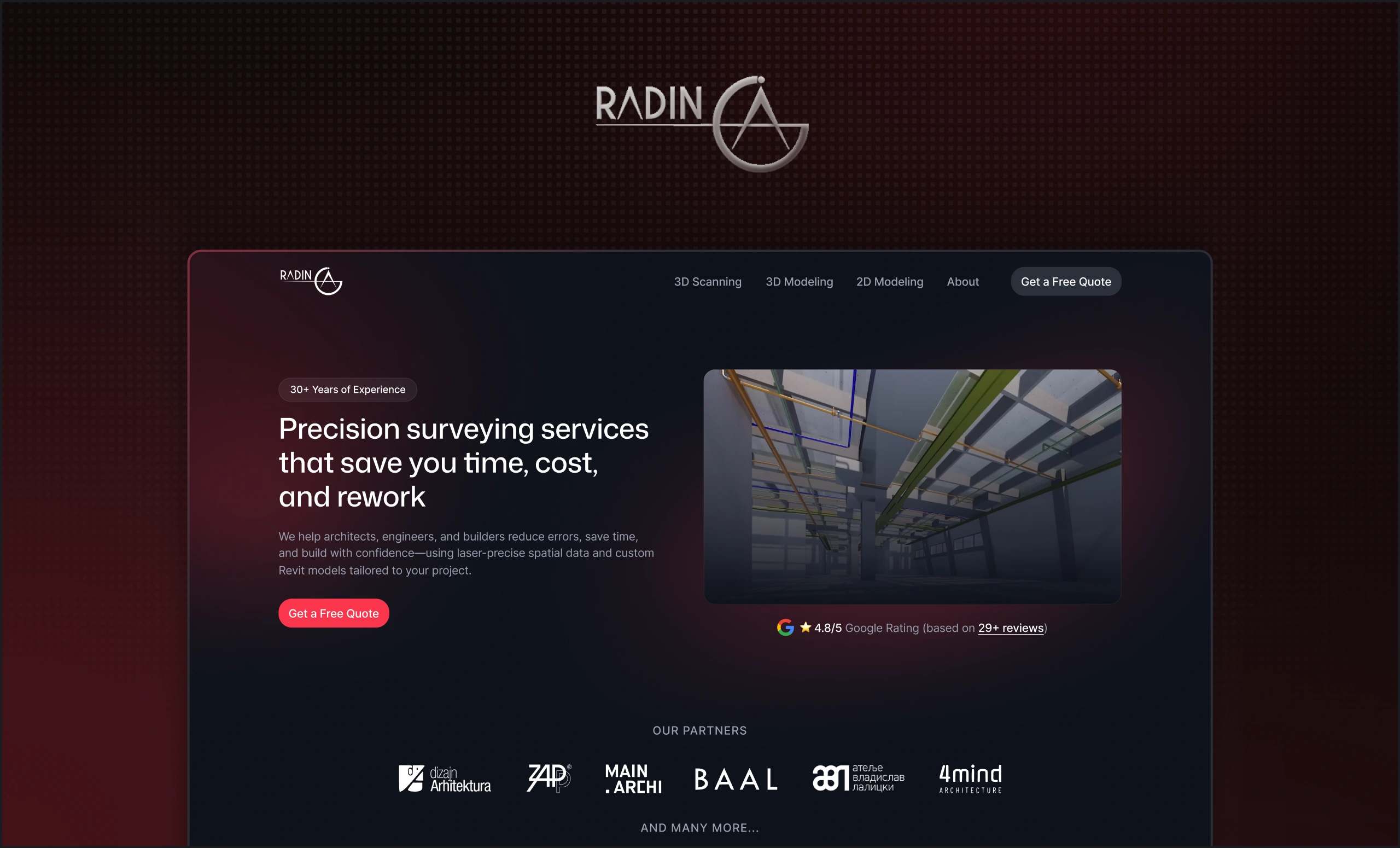
Radin is one of Europe’s leading providers of precision 3D surveys and Revit models.
Apr. 2025 - Feb 2026




Our Approach
1. Strategy & Research
We began with a discovery phase to understand business objectives, target audience, and competitive landscape. Through workshops and UX audits, we identified friction points in the current experience and defined measurable success metrics.
We mapped out a new site architecture focused on clarity, hierarchy, and conversion-driven storytelling.
2. UX & UI Design
Our design process focused on:
- Clear messaging hierarchy
- Conversion-focused layouts
- Strategic use of whitespace
- Custom illustrations and visual elements
- Accessibility best practices
Every section was intentionally crafted to guide users toward action.
3. Webflow Development
We built the site in Webflow using a scalable, component-based structure:
- Clean class naming system
- Modular sections for future flexibility
- Dynamic CMS collections for blog, case studies, and resources
- Optimized interactions and animations
- Fully responsive breakpoints
Performance and maintainability were priorities from day one.
4. Performance Optimization
We implemented:
- Image optimization and modern formats
- Reduced render-blocking assets
- SEO best practices (meta structure, semantic HTML, alt tags)
- Structured CMS fields for search visibility
The result was a fast, lightweight, and scalable website.
Frequently Asked Questions
What does RadinAG do?
RadinAG is one of Europe's leading providers of precision 3D surveys and Revit models.
What was the main outcome of the RadinAG project?
The Webflow rebuild tripled conversions for RadinAG.
How did Flowscape approach the RadinAG redesign?
The project followed four stages: strategy and research, UX and UI design, Webflow development, and performance optimization.
How long did the RadinAG engagement last?
The work ran from April 2025 to February 2026.
How was the RadinAG site built for future growth?
It was built in Webflow with a component based structure, a clean class naming system, modular sections, and dynamic CMS collections for blog, case studies, and resources.
Explore more case studies



Let’s turn your website into a growth engine


